‘Fleximatise’
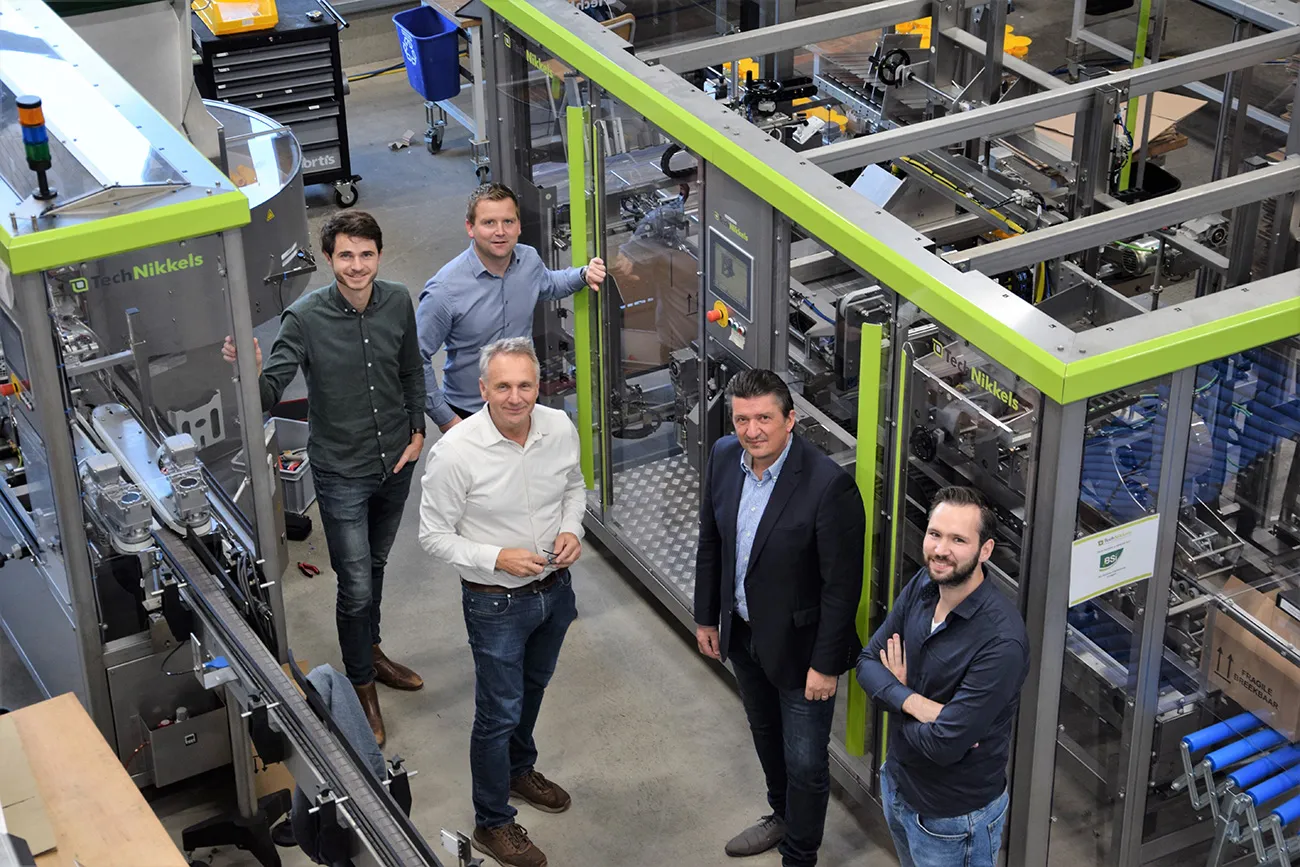
At TechNikkels, the motto is ‘fleximatise’: automate, but with flexibility. The company develops and builds machines for feeding, filling and sealing bottles, jars and (quadrangular) cans, as well as American folding cartons, specifically for companies that process a wide variety of them. Lenze is its partner for automation.
Managing director and founder Henk Nikkels earned his stripes in the special-purpose machinery sector at several major industrial companies. He founded TechNikkels in 2003 and began developing its own filling and packaging line in 2011. The company has since come of age and is now fully committed to servitisation. ‘Whereas the focus used to be mainly on building high-quality, flexible machines, it has now broadened to ensuring that customers get the maximum performance from our machines. Because we operate locally in the Netherlands and Belgium, we can also respond to queries very quickly. We prefer to do this remotely, but if necessary, we can get on site quickly. In five years, things may be different, and we may be able to serve new markets more easily because we will have further developed remote support using all the tools available.’
Performance is key
TechNikkels’ machines fully automate several operations in the packaging process, such as feeding packages, filling and closing them, and packing them into a box. ‘Not only can packaging vary greatly in shape and size, but also in the material used and the tolerances in its thickness,’ explains Thijs Krijgsman, sales and service director at TechNikkels. Tests are carried out using a clear plastic bottle processed on a high-speed machine. ‘We want to deliver not just a machine or a line, but also optimal performance from that machine and a reduced carbon footprint. This means we also provide proactive advice and develop solutions in the area of monitoring.’ Industry 4.0 and digitalisation can help with this. One example is creating dashboards to improve OEE. ‘We have a lot of data that enables us to continue developing and optimising. Data from the machine is purely factual. This lets you analyse production and see exactly where you can improve. In a way, you substantiate your OEE with objective data. Our aim isn’t to tell customers how to do things, so we provide tools that help them focus on the right areas.’
Flexibility
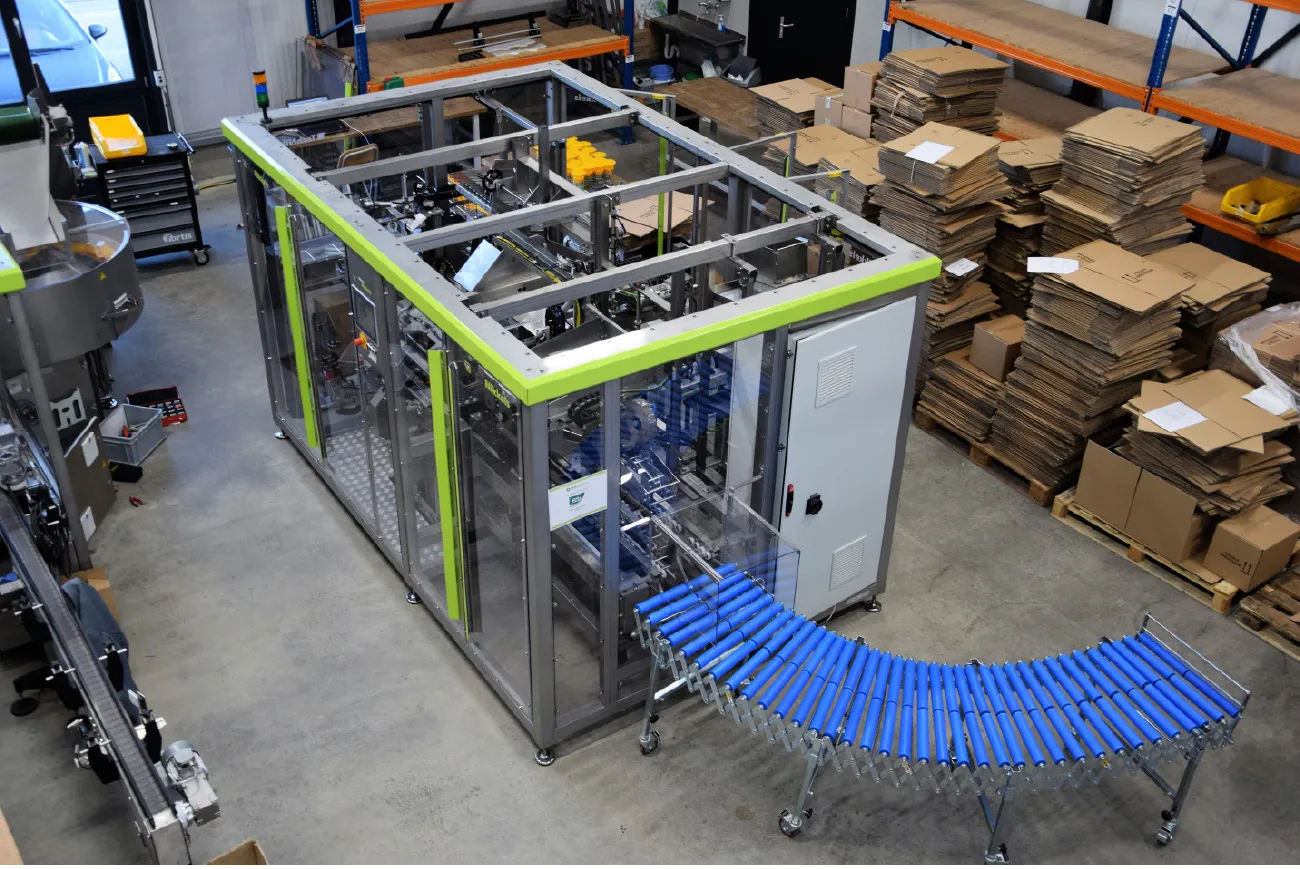
TechNikkels’ flexibility is reflected not only in the types of packaging a machine can handle, but also in how it is used: operation, changeover, control and more. ‘Our machines are specifically designed for a wide range of products. That’s what sets us apart,’ says Krijgsman. ‘That’s why all our machines can be changed over very quickly, even fully automatically. Batch sizes are often small nowadays, and product life cycles are short. Being able to change over quickly and easily, without errors, is essential. Everything is designed to make the line easy to use, including with staff turnover in mind. In fact, anyone can operate this machine.’ Nikkels explains: ‘Everything in the machine is geared towards handling variation. We choose the right technology for each process, for example, placing bottles in the box. We try to use as many components as possible from a single source, so that everything is coordinated from the outset.’
Remote support
For remote support and condition monitoring, the programmable logic controller (PLC) acts as a gateway to the outside world. The PLC becomes both an actuator and a communicator. Stefan van Dooren, Lenze project manager, explains how it works: ‘All the data is displayed on a dashboard. This adds real value, because everything is coordinated. It really is an end-to-end solution. And the dashboard is an excellent tool for monitoring OEE.’ Krijgsman adds: ‘Showing figures isn’t difficult. What matters is the information and context. Customers want dashboards to be as simple as possible, presenting information clearly in a way that everyone can understand. We ask the customer what information matters, then create a clear dashboard based on their requirements and objective information. A production manager can use it.’ Nikkels sees further possibilities: ‘The HMI can be a decisive factor in the operator’s job satisfaction. But for us, being able to reduce downtime by monitoring the process remotely is important. That way, you can provide support very quickly when production stops.’
Maximum support
Another example is a large special-purpose machine that TechNikkels built in 2014 for packaging wrapping paper. At the same time, the company already had an order underway for a large line. ‘We had to work smart, because both orders had very short lead times and it isn’t easy to allocate staff at short notice. We contacted Lenze about the orders for both projects, and we understood each other straight away. We got the maximum support to deliver both projects within the required timeframes. This was at the start of our cooperation, and I have to say we’re very pleased to have Lenze as a partner, both in automation and in operational technology. We’ve since completed several projects together and are very satisfied.’
Managing your installed base
OEE is therefore not an issue. But asset management also benefits from objective data and information. Daan Nikkels, service business development manager at Nikkels, explains: ‘If you can keep track of the installed base effectively, you can build learning capacity using a history of queries and incidents. All inspections are documented, giving you, in short, a complete history of your installations. We’re currently running a pilot project with Lenze, in which customers send us all their queries through a single portal. It’s very accessible, but it only works if customers adopt the new solution.’ Van Dooren is Lenze’s project manager for the pilot: ‘The platform lets us provide remote maintenance. We record all information about faults, for example, and all the documentation is also stored on site. Everything is centralised, with a complete historical overview.’ Developments are moving fast. Nikkels says: ‘Automation will become increasingly important. Not just to save money, but out of sheer necessity, because it must be possible to operate a line with fewer people. There’s a shortage of people, resources and materials, so it’s a real advantage if your supplier is nearby.’
Question about this story? Ask your question
Companies in this story
Keep following this
Get an email when a new story is published. No account needed.
- ThemeHigh-performance drives and precise motion
- SubjectServices & solutions
- CompanyLenze