Complete safety overhaul of a 100-tonne press
Texte & photos Luc Ophals
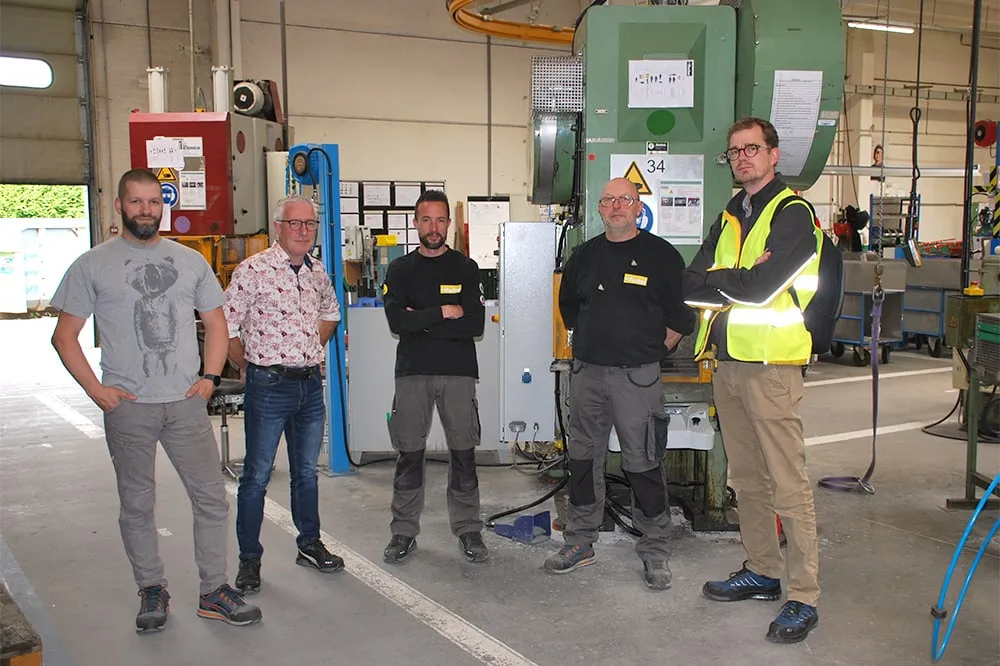
Every industrial production site must make its equipment as safe as possible to minimise risks to personnel operating production machinery and equipment. Approved and implemented safety procedures also need to be reviewed at regular intervals to ensure they remain as reliable as possible. This is all the more important for machines that may be very old and operate in constant interaction with the operator. The recent collaboration between PILZ and Purolator Advanced Filtration illustrates the complexity of the process.
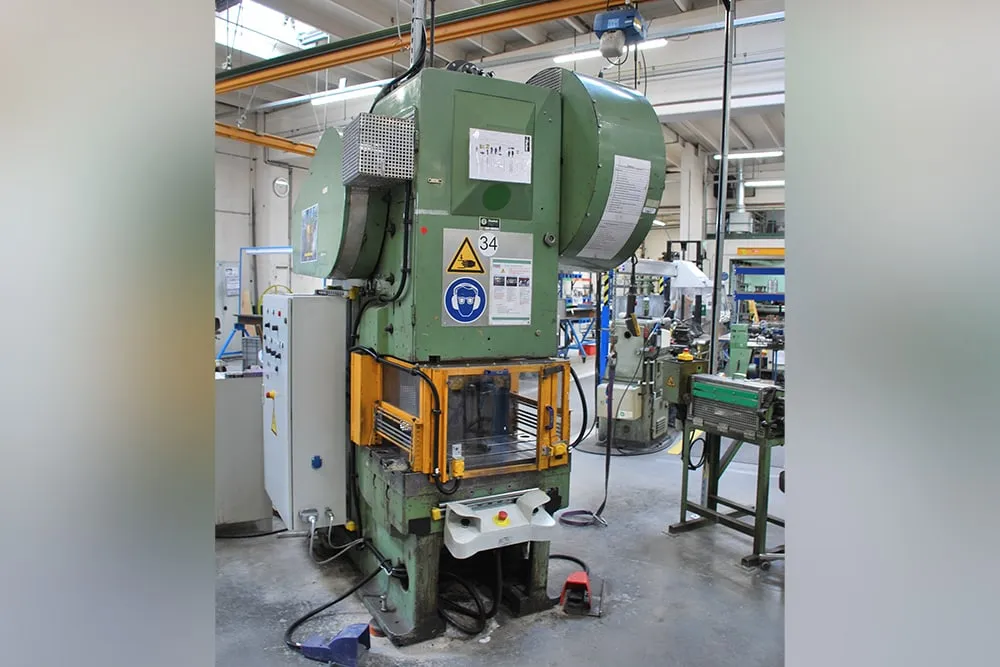
Purolator Advanced Filtration, part of the global Parker Hannifin group, manufactures filters from ferrous and non-ferrous metals, wire mesh filters, high-flow filters, pressure filters and strainer filters, among others, for the automotive and chemical industries, in a wide range of sizes (from 30 mm to 835 mm). Several stamping presses are used for this purpose, including a 100-tonne mechanical press of Soviet origin dating back to the 1960s. An isolated accident at one of Parker’s sites worldwide prompted a thorough review of safety on this type of machine. As the Parker group already worked with PILZ, a specialist in machine safety automation, the management of Purator Advanced Filtration naturally chose to draw on the local presence and expertise of Pilz Belgium.
The safety project is based on a detailed risk assessment
“First of all, it is worth noting that the mechanical stamping press, which dates back to the 1960s, pre-dates the 1995 Machinery Directive and therefore did not bear CE marking. It must comply with the Work Equipment Directive. This involves, among other things, reassessing the machine’s conformity at regular intervals (approximately every five years) by carrying out a risk assessment in accordance with EN12100,” begins Jérôme Thonar, Service Manager at Pilz Belgium and the safety project lead. “We carried out a thorough on-site risk assessment, not only for this 100-tonne press but also for the two other presses of the same type, which have lower capacities. We then proposed the safety measures to be implemented, based on how our client uses the machine, to meet a required performance level of PLr d for certain safety functions. The 100-tonne press has a mechanical drive system with a pneumatic clutch-brake between the flywheel and the drive shaft. To ensure a high level of reliability, the only option is to use a certified safety controller with certified safety blocks as well,” Jérôme explains.
The solution implemented
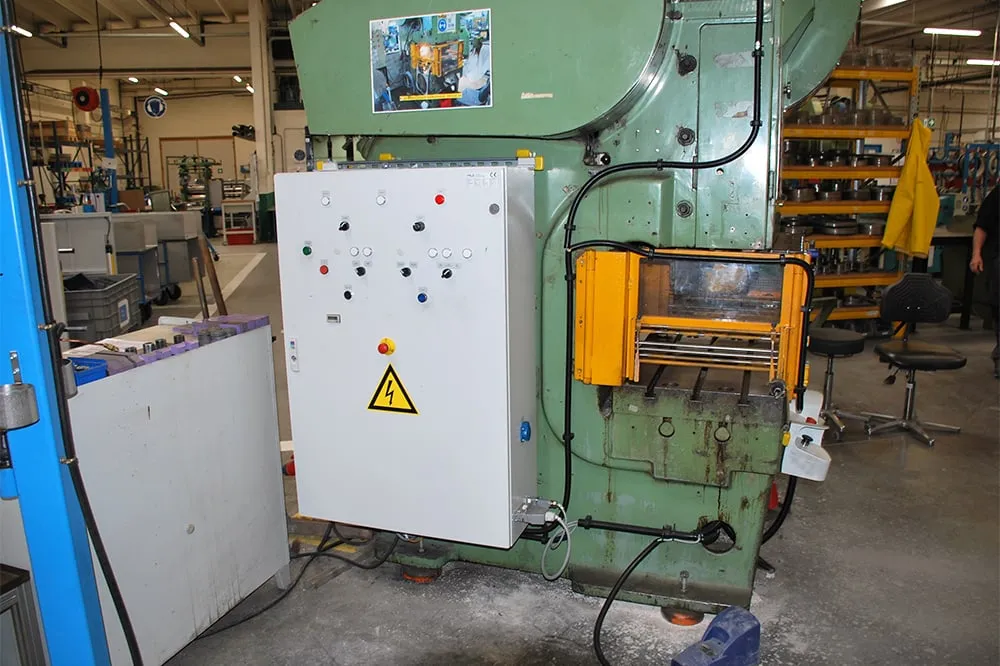
“As for operation and the operator interface, we installed a two-hand control to enable the operator to work with the movable guards open, as well as a pedal control for working with the movable guards closed.
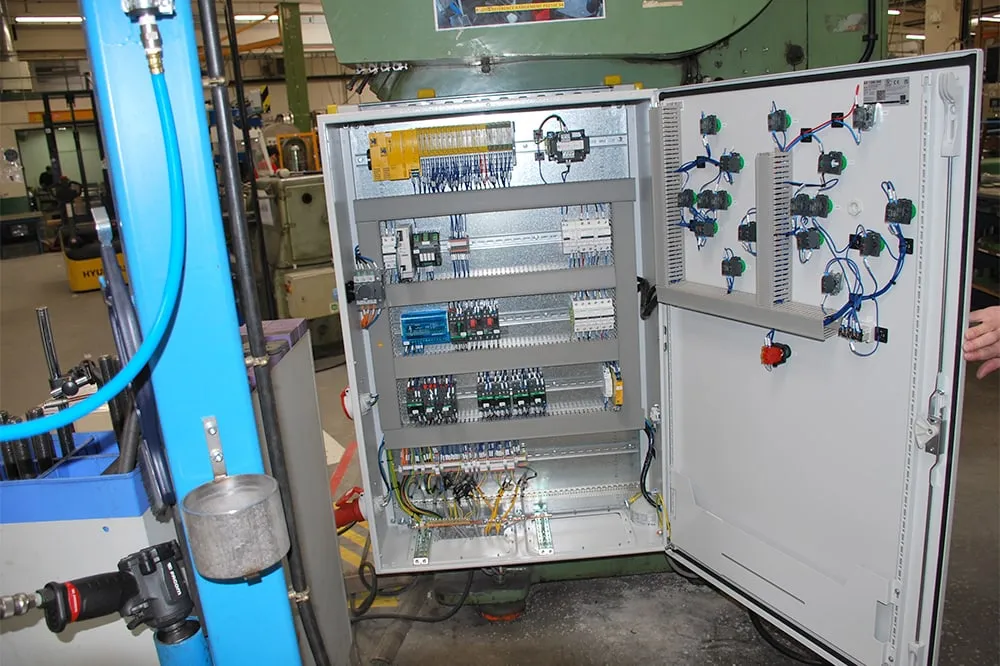
Communication with the PSS4000 safety controller is via a PILZ safety encoder mounted on the machine’s main shaft, providing a performance level of up to PL e. We needed to use our safety encoder to provide channel redundancy and monitor the connecting rod’s 360° rotation. The pneumatic clutch is controlled by a safety solenoid valve certified up to PL e.
“Finally, to make maintenance operations safe when access to the drive system is required, the first press of the two-hand control immediately cuts the electrical supply to the press flywheel motor. This means that the machine’s downstroke is driven not by the motor but by its inertia, with the rotation slowing progressively and the force decreasing accordingly,” explains Jérôme Thonar.
The project therefore included installing a new electrical cabinet and completely rewiring the machine’s peripheral equipment. Once the safety solution had been implemented, the safety controller programme was validated and all the necessary functional checks were carried out. In the next phase, a safety manual was drawn up for the machine’s operators and training was provided. Gwenael Herbillon, Quality, Safety and Environment Manager at Purolator Advanced Filtration, adds: “We have a very broad range of products and tools. Some production runs for less common products sometimes require us to go beyond the usual scope and take new variables into account. This means the parameters have to be adapted to these specific situations.” Jérôme Thonar adds: “At that point, we tested the heaviest and lightest tools. We configured everything according to the tools and standards. The diversity of the products therefore imposed a flexibility constraint. In the end, however, using all the data entered for the installed equipment in our performance level validation programme, we were able to provide a report confirming that the required performance level had indeed been achieved, and that it was even PL e.”
This safety project on the 100-tonne stamping press validated the concept and demonstrated the value of working with Pilz. The press is the workhorse of the Sprimont company, as it runs more than any other machine and is therefore likely to pose the greatest risks. After identifying the major risks associated with this equipment before its refurbishment and assessing the quality of the machine once brought into compliance (reduced risk to operators, no loss of flexibility or productivity, easier and safer tool handling, legal compliance, etc.), the company optimised its investment by deciding to retain only four of its six presses and bring all four into compliance. The next phase will therefore be to extend the safety level achieved today to the other three presses.
Een zakelijke vraag aan Pilz Belgium? Get in touch
Companies in this story
Keep following this
Get an email when a new story is published. No account needed.
- ThemeSafe and compliant machinery
- SubjectServices & solutions
- CompanyPilz Belgium