A mobile robot on the shop floor requires special attention to safety
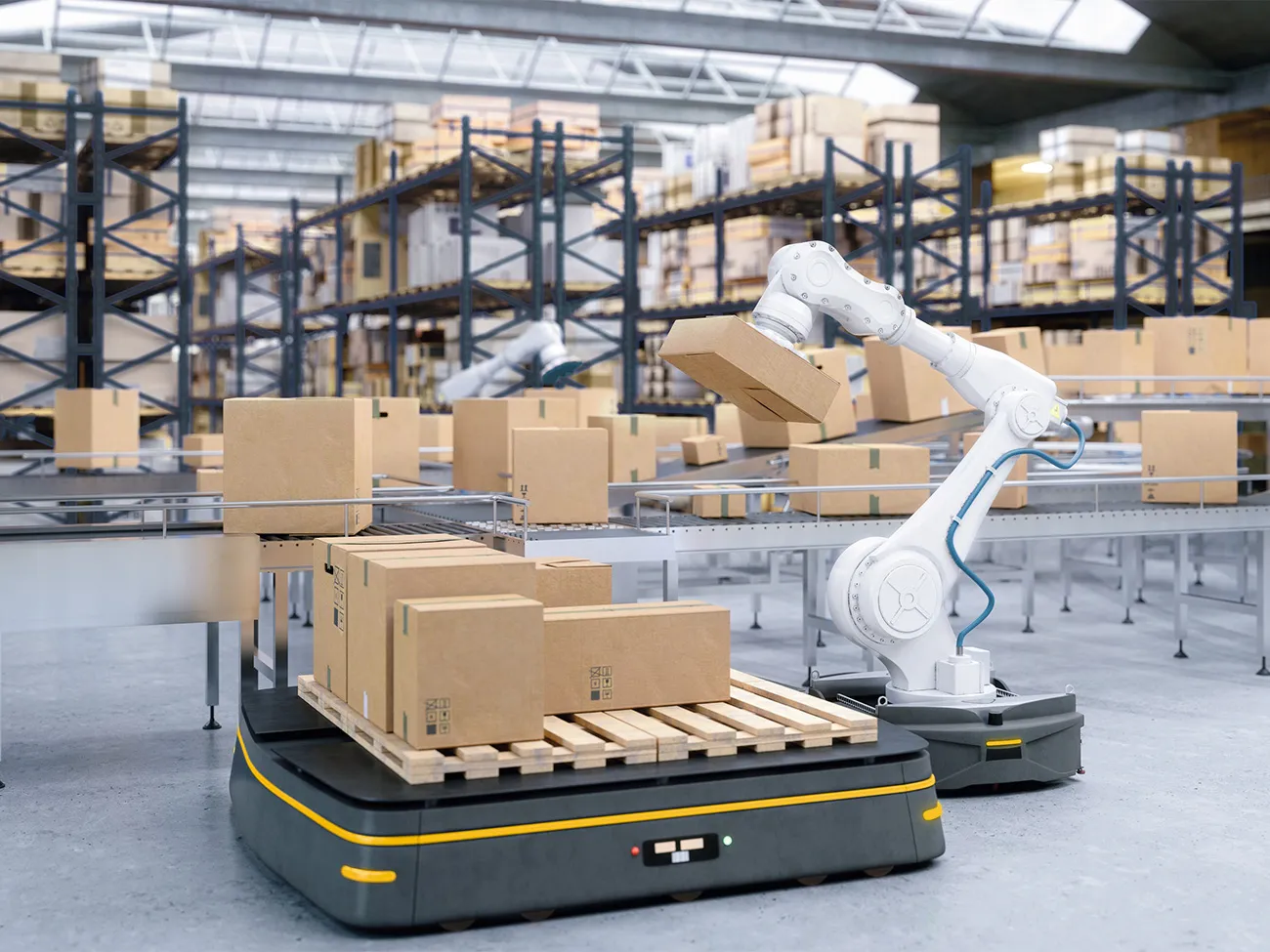
Automated guided vehicles (AGVs) are operating at an increasing number of production sites. They completely transform logistics processes. Shop-floor employees need to get used to them, and the AGVs must also be 100% safe. That is why Pilz, the global leader in automation technology for safety, helps production companies purchase and commission all kinds of automated vehicles for intralogistics. “After all, you are bringing robots into your own facility.” Pilz offers a service package for the growing number of companies using driverless transport vehicles.
Companies investing in an AGV system sometimes overlook the many implications for the shop floor and what is required. For example, they give their supplier a plan of the production site, then some time passes before the system is delivered, and by then not everything matches up any more. Or they expect that reducing the number of forklift trucks with drivers on the shop floor will automatically lead to fewer accidents, whether minor or major. An AGV may also stop much too abruptly, causing its entire load to topple over. Robots might also head automatically for the charging stations, giving unsuspecting employees a nasty fright. An AGV can drive with centimetre-level precision, so it may seem that such a vehicle does not need much space either. However, it is a forklift truck that needs to be able to manoeuvre freely. Some AGVs carry boxes of injection-moulded plastic parts, while others transport 20 tonnes of goods. If an AGV is to set down or transfer its load, or work alongside a person, this places significant demands on safety. Suppose a pallet full of parts is being transported somewhere on the shop floor: how can you prevent someone from getting trapped?
New standard
It goes without saying that there are all kinds of rules and standards. Anyone designing and building driverless autonomous transport vehicles or complete systems with multiple vehicles must comply with the guidelines in ISO 3691-4. This ISO standard defines safety requirements and specifies how the automated vehicle functions must be validated. It also describes the required performance for the various operating modes and for brake control, among other things. The new ISO standard was essential in view of the rapid development of technology. In addition, the existing EN 1525:1997 standard was already 24 years old. The new standard is more comprehensive and specific, particularly when it comes to integration on the shop floor. It also sets out requirements for companies deploying AGVs in their processes. These include, for example, appropriate zoning on the shop floor. In Europe, EN 1175:2020 supplements the ISO standard for AGVs. This European standard focuses primarily on electrical aspects.
An attractive market
Meanwhile, an increasing number of AGV suppliers are emerging. Some are now highly experienced and supply good machines. But among these suppliers are also newcomers looking to tap into an attractive market. The subject is complex, which is why Pilz has developed a service package for industrial companies. Experts support the process, from AGV design and purchasing through to regular checks once the robots are operating on the shop floor. Purchasing, building and introducing the systems often involve collaboration between several parties. The AGV supplier designs and assembles a system, the customer has certain requirements, and other information technologies are involved: the systems need to communicate with each other and provide the right information.
Pilz’s service package for the safe operation of automated transport systems comprises several components. First, there is a design risk assessment. To carry this out, Pilz assesses the risks on the basis of the AGV supplier’s design drawings. Nothing has been built for a customer yet. Pilz’s safety engineer examines the design features and checks that the design complies with standards and legal requirements. What needs attention? Are potential risks covered? Does the AGV brake in time, and does it avoid braking too abruptly? Gaps can be found both among newcomers to the market and experienced suppliers, because every AGV of this kind has to address customer-specific requirements. The customer receives an inspection report from Pilz and can immediately see what is necessary or recommended to make an AGV safer, or to improve future productivity on the shop floor.
Shop-floor culture
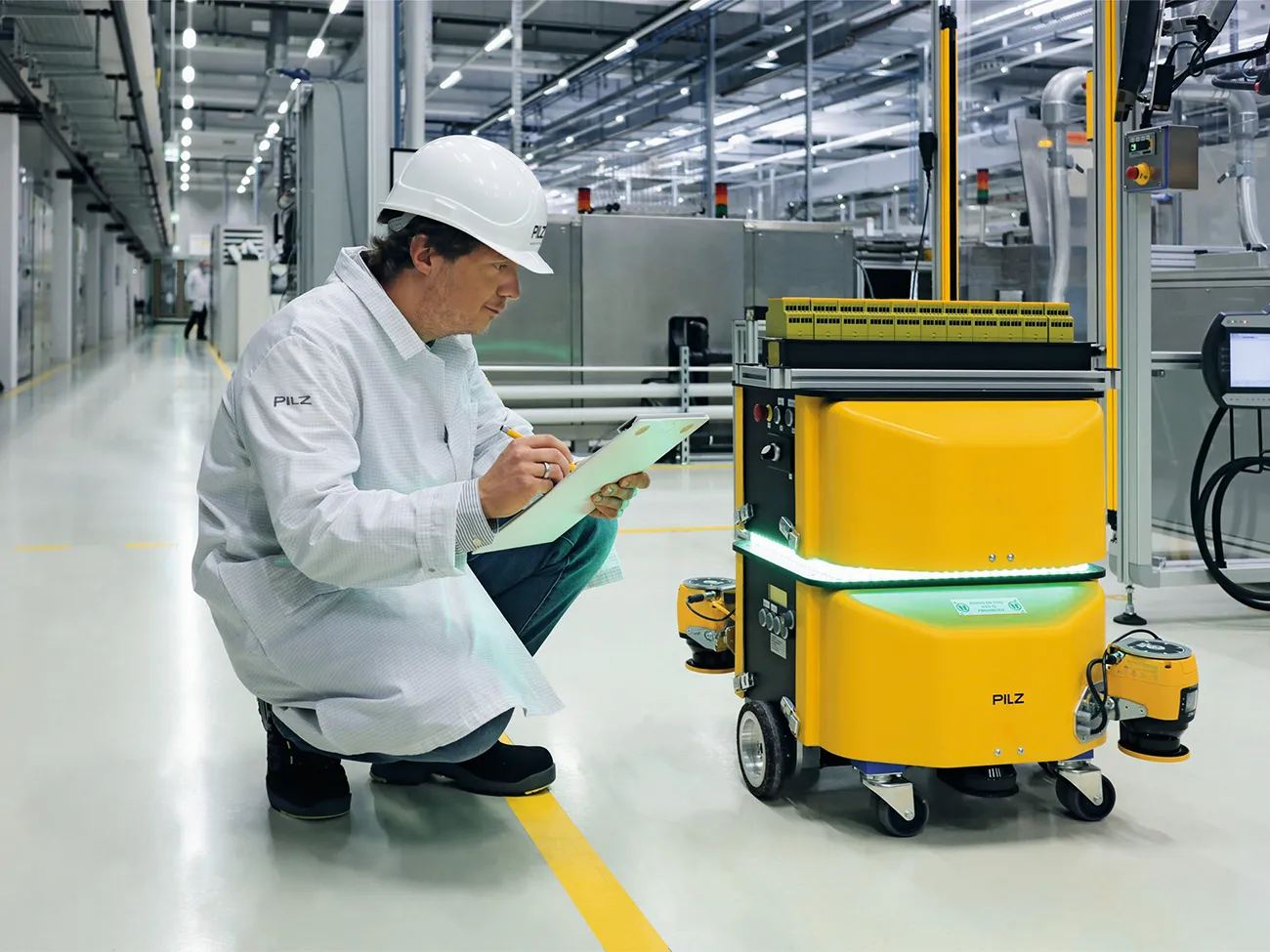
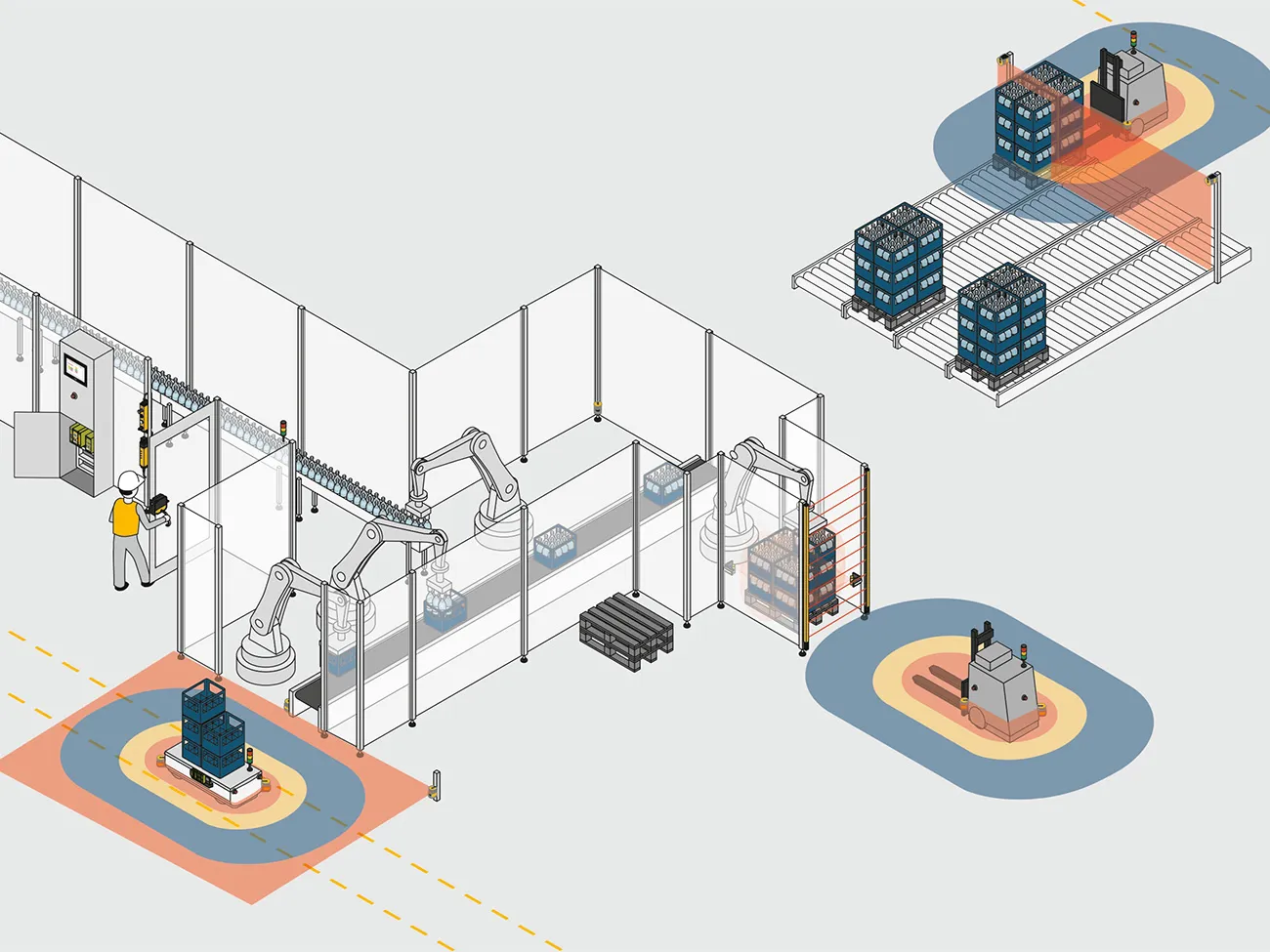
Next comes the factory acceptance test (FAT), a detailed analysis of the key safety functions of a ready-to-use AGV. This involves thorough testing at the production site or in the warehouse. It is often a sizeable mobile machine that changes the way work is done. How do employees work with the AGV? How does it now fit effectively into operations and the wider environment, and what risks does it present? Pilz lists all kinds of measures that are necessary or recommended as part of the FAT.
Finding the right balance
Speed is also an important factor: the load carried by an AGV affects its braking distance, and vice versa. A supplier builds a model and tests it. But the robot then goes to the customer, who wants the machine to run a little faster or, for example, to raise its forks while driving. All modifications must be documented very carefully in the safety system. The final application at the customer’s site may still reduce the level of safety. It often comes down to a discussion about performance versus safety, but there is usually a middle ground. Pilz takes an objective view: does everything comply with the standards, and is safety assured for a specific application in a particular production environment?
Ongoing attention
If necessary, Pilz also carries out site acceptance tests: risk assessments and inspections of AGVs and complete systems that are already operational. Where are they used? Is the environment set up for them? Has anything changed? Are the safety devices still suitable? Training is also provided for shop-floor employees: what do they need to bear in mind now that robots for intralogistics are being commissioned? Pilz helps your organisation ensure the safe commissioning and maintenance of AGVs.
Question about this story? Ask your question
Keep following this
Get an email when a new story is published. No account needed.
- ThemeFlexible robotics and autonomous logistics
- SubjectServices & solutions