Will all construction machinery be electric in the future?
Texte Johan Debaere | Photos Elsto
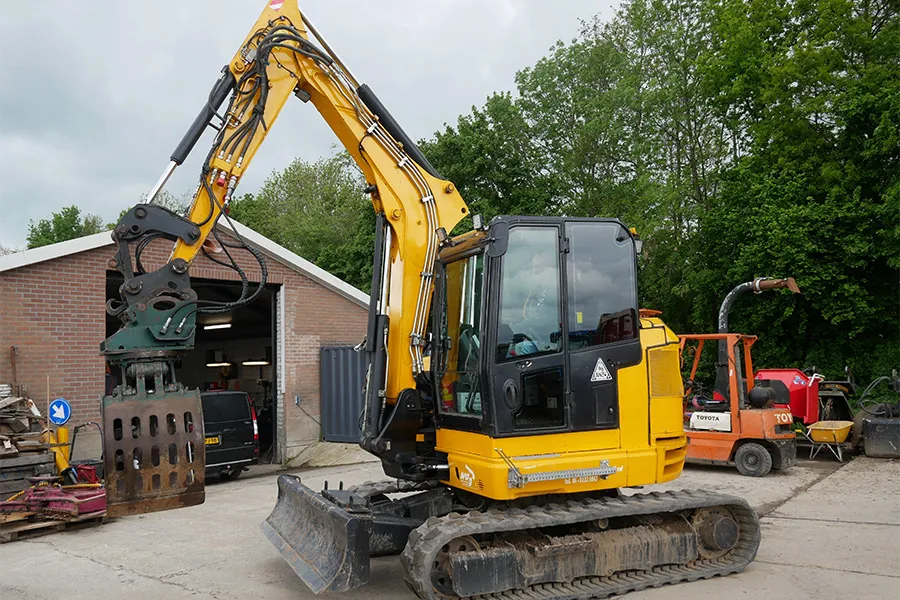
Clients commissioning construction projects in city centres and natural areas increasingly want everything to be as low-polluting as possible. As a result, demand for electric construction machinery is rising sharply, but supply remains limited for now. Many MEWPs are already electric, but other machines, such as small earthmoving equipment and telescopic handlers, still almost always run on conventional power. Elsto Drives & Controls is following this development closely. The drive and control specialist took part in a successful project to convert a diesel-powered crawler crane into an electrically powered machine.
From diesel to electric drive
Climate measures and emissions standards introduced worldwide are increasing the need for zero-emission, electrically powered construction machinery. These machines also offer other benefits. Although the initial investment is higher than for machines powered by an internal combustion engine, overall operating costs are significantly lower. They are also quieter and produce less vibration, while being more precise and quicker to operate. Yet the shift to electrification appears to be slow at present. While half of all MEWPs are already electrically powered, the proportion remains fairly low for small earthmoving equipment and telescopic handlers.
Construction machinery will therefore mostly be electric in the future, but today’s reality is different. That is why Wilco Donselaar, owner of Kraanverhuur- en Loonbedrijf W.G. Donselaar VOF in Leerdam, the Netherlands, decided to convert a four-year-old, 8.5-tonne crawler crane from diesel to electric power himself. This specialist in earthworks, sewer works, landscaping, waterway maintenance, paving, dredging and tree felling aims to meet demand from municipal authorities, nature reserve managers and other organisations.
Ben Donserlaar, the owner’s brother, took on the challenge of carrying out the project through his one-man business specialising in maintenance work. When Ben needed new components for repair and overhaul jobs, he often chose solutions from Elsto Drives & Controls. He also turned to the Voorhout-based mechanical and electrical drive specialist for this unique project.
AC motor and battery pack
“Our engineers took to the project straight away and took the time to think it through with us. A lot of calculations had to be done first. We eventually opted for a standard 230/400 V three-phase motor, delivering constant torque up to 2 500 rpm. This gave us energy efficiency of around 93%. The alternative we considered was a servo motor, but that is considerably more expensive. We also wanted to gain experience of how an electric drive performs on a crawler crane of this kind. In this case, a standard induction motor was the simplest solution, and this type of motor is also readily available,” explains Bert Vanpeteghem, Sales Director at Elsto Drives & Controls. “Our three-phase motor is powered by an ELEO Technologies battery pack via a Bonfiglioli Vectron frequency converter. A V-belt drive connects our motor to the crane’s hydraulic pump. The travel, boom movements and tool are still operated by the hydraulic drive. The lighting and controls are powered by the existing 12 V battery.”
The proof is in the practice…
This electrically driven crawler crane has been operational since August 2020 and has since proved its worth. Customers are now specifically choosing Donselaar because they can work without emissions.
“Measurements show that the motor requires a rated power consumption of 22 kW at a frequency of 87 Hz, and no more than 28 kW at peak times. However, average power consumption is much lower, allowing the machine to run for more than 10 hours without an interim recharge. The motor can run faster, but in most cases there is no need,” concludes Bert Vanpeteghem. “The crawler crane is also remarkably quiet, as the electric motor and frequency converter are inaudible from the outside. The frequency converter also makes it possible to collect, store and read all kinds of data: actual operating and standby hours, current, voltage and power… With a communications module and a USB cable, this data can be viewed on a laptop, and with 4G the crawler crane can even be monitored remotely.” ■
A business enquiry for ELSTO Boekholt? Get in touch
Companies in this story
Keep following this
Get an email when a new story is published. No account needed.
- SubjectNews
- CompanyELSTO Boekholt