Open, compatible EtherCAT technology, proven in practice for 20 years
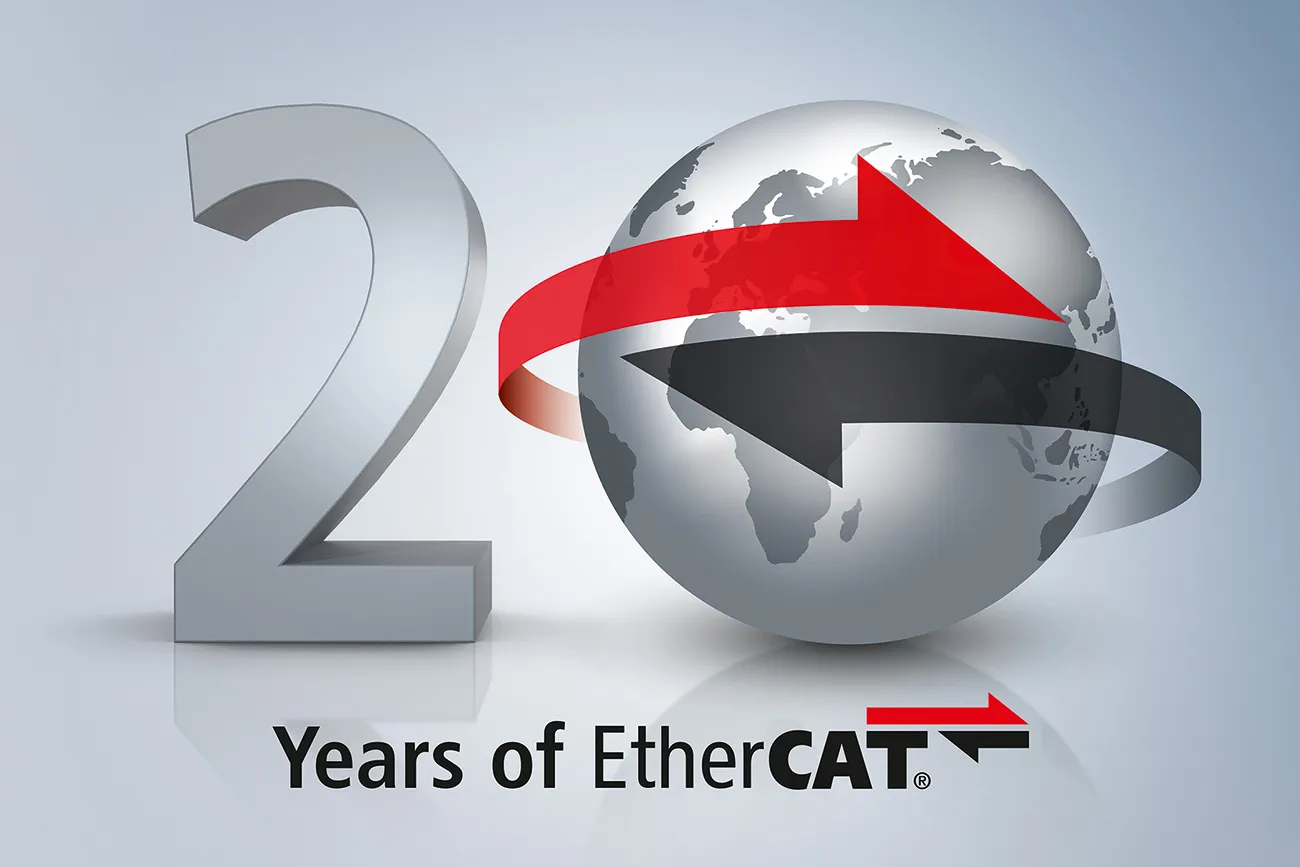
The communication system developed by Beckhoff and presented at Hannover Messe 2003 has proved itself as a high-performance, real-time Ethernet technology. EtherCAT has established itself firmly on the market through its continuity and technical development, and has even become an open IEC standard. Today, EtherCAT offers the performance and innovation potential to meet the demands of the next 20 years of advanced automation.
Two decades since EtherCAT communication was launched at Hannover Messe
Beckhoff has always been known for its high-performance control systems and for continually pushing the boundaries of performance in the world of automation. This is all based on the principle of PC-based control technology, which makes it possible to harness all the advantages of a PC, particularly its high computing power, directly on the machine. EtherCAT was developed to make the most of the high-performance Ethernet interfaces available as standard on PCs in the early 2000s for machine automation. Twenty years later, this is truer than ever.
That said, the standard Ethernet protocol is designed to transmit large volumes of data and long data frames, rather than the small units of information commonly found in machine environments, such as a 1-bit limit switch value or a 16-bit analogue value.
This is where the principles behind EtherCAT brought the two worlds together in an ideal way, delivering a number of major benefits:
the standard Ethernet frame is used, so no special communication card is required in the master
with the development of the Fieldbus Memory Management Unit (FMMU), data can be processed as the frame is transmitted, optimising protocol efficiency without overloading the master
Ethernet’s point-to-point connection is crucial to ensuring optimum diagnostic capabilities for EtherCAT
distributed clocks introduced a highly accurate, automatically synchronised system time, providing the basis for modern control concepts based on time slices
alongside this well-designed technology, its publication through the EtherCAT Technology Group (ETG) also contributed to widespread acceptance and success.
One of EtherCAT’s unique selling points is that the technology itself has not needed to change for more than 20 years. The basic protocol embedded in the chip has remained the same and has only ever been extended while maintaining full backward compatibility. The same applies to Safety over EtherCAT, which is also backward-compatible. Even 100 Mbit/s devices can still be integrated into and used in EtherCAT G networks. This means that a current EtherCAT device will still work in a 20-year-old factory. It also means that EtherCAT technology does not create bottlenecks in the control architecture, and for most applications this will continue to be the case at 100 Mbit/s. EtherCAT G, meanwhile, offers sufficient potential to meet even the most demanding requirements of the next 20 years, without difficulty and without a technological break.
Een zakelijke vraag aan Beckhoff Automation? Get in touch
Companies in this story


Keep following this
Get an email when a new story is published. No account needed.
- ThemeReliable and open industrial networks
- SubjectNews
- CompanyBeckhoff Automation
- CompanyHANNOVER MESSE