When the robot writes the greeting card
US engineering company deploys handwriting robots equipped with igus maintenance-free linear and lead screw technology
Emails, instant messages and printed greeting cards: communication in the business world is quickly becoming impersonal. A robot from Arizona-based Spline Product Development wants to change that. Thanks to igus maintenance-free linear technology, cards can be handwritten, making messages more emotional and impactful.
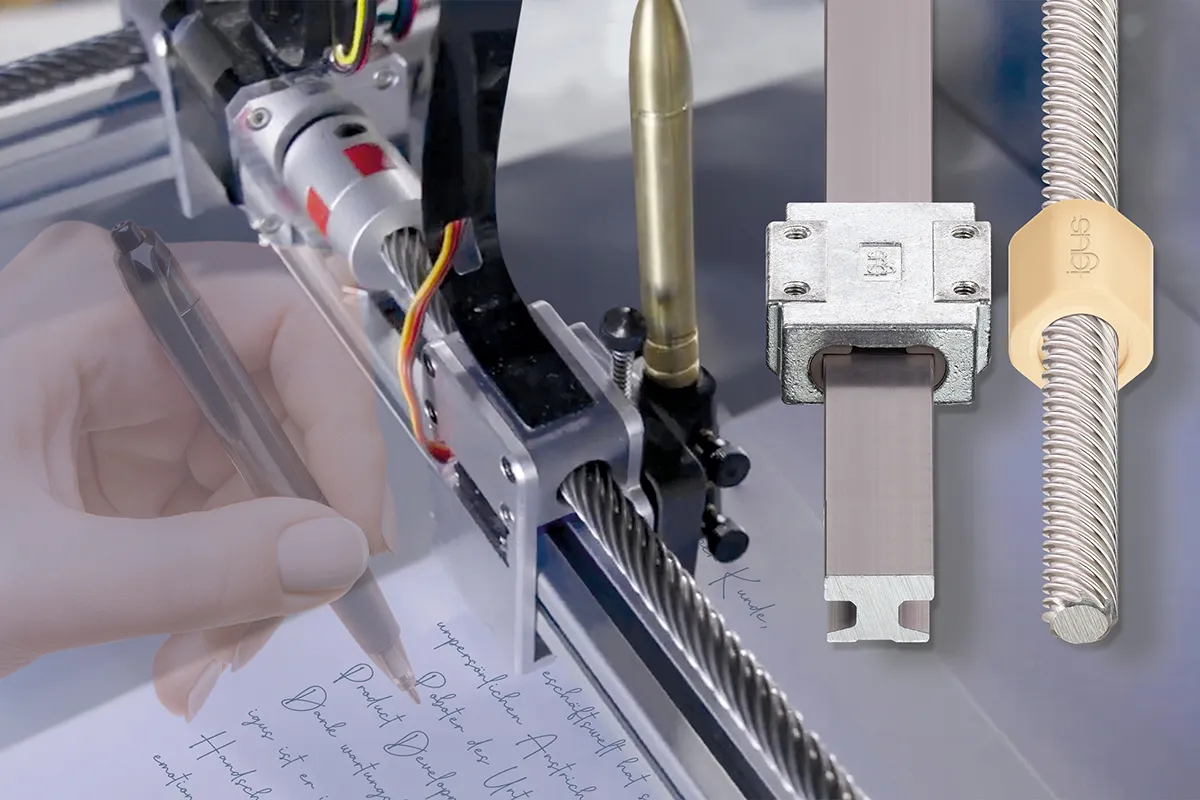
A personalised card from your favourite online shop? That is exactly the kind of special promotional mail that recipients in the US are receiving at the moment. Engineers at Spline Product Development have made it possible. The American developers’ handwriting robot looks like a compact 3D printer. At its heart are three linear axes that move a ballpoint pen. Its positioning is so precise that the robot can even imitate the nuances of a predefined handwriting style. It is designed for companies that want to send their customers letters with a personal touch. According to marketing experts, these generate far more responses than plain letters printed on a conventional printer. The handwriting robot is currently being used by Simply Noted, a supplier based in Tempe, near Phoenix, US.
igus linear technology enables robots to write as precisely as humans
As elegant and fluid as the robot’s work may look, achieving its precise movements presented a major technical challenge. Earlier models worked, but were slow and prone to wear. This led to high maintenance costs, according to the engineers at Spline Product Development. The handwriting results also left much to be desired. The experts only made significant progress when they turned to igus linear technology. The solution combines miniature drylin T aluminium linear guides, preloaded linear carriages, a dryspin lead screw drive and electric stepper motors. Two of the linear guides are parallel, around 50 cm apart. The linear carriages travel along their rails and hold a third linear guide vertically. The pen is mounted on another carriage, which moves horizontally along the third linear guide. The synchronised interaction of the axes allows it to reach any point in the writing area. When the pen starts writing, the highest level of mechanical precision is essential.
“The stepper motors enable precise carriage movements, down to the millimetre, using lead screw drives, in cycles lasting just a few milliseconds,” explains Roy Snellens, drylin product manager for linear technology and drive systems at igus. This high level of precision is made possible in part by the innovative thread geometry of the dryspin lead screw. The flank angles of the screw nuts and lead screw are shallow, resulting in an above-average efficiency of 82%, which helps ensure precise positioning. “This positioning accuracy allows the robot to write with the same fine motor skills as a human, where more than 30 different muscles in the hand, arm and shoulder work together during writing.”
One card after another: no external lubrication means high reliability
Thanks to igus linear technology, the handwriting robot is not only more precise, but also requires less maintenance. The reason: the linear guides need no external lubrication. The high-quality plastics used in the screw nuts and sliding elements, along which the linear carriages travel on the rails, contain solid lubricants that are released gradually during use, enabling dry, low-friction operation.
“Thanks to this self-lubricating effect, the handwriting robot can operate without failure, even in dusty environments,” explains Snellens. “Unlike lubricated systems, there is no risk of dust and dirt from the surroundings mixing with the grease to form a compound that impairs the precision of the positioning movements.”
The robot can therefore write thousands of greeting cards for companies without tiring and without the need for troublesome maintenance work.en.
Een zakelijke vraag aan igus? Get in touch
Companies in this story
Keep following this
Get an email when a new story is published. No account needed.
- ThemeFlexible robotics and autonomous logistics
- SubjectMotion & drives
- Companyigus