Everyday assistants of the future: igus boosts humanoid robotics with low-cost automation
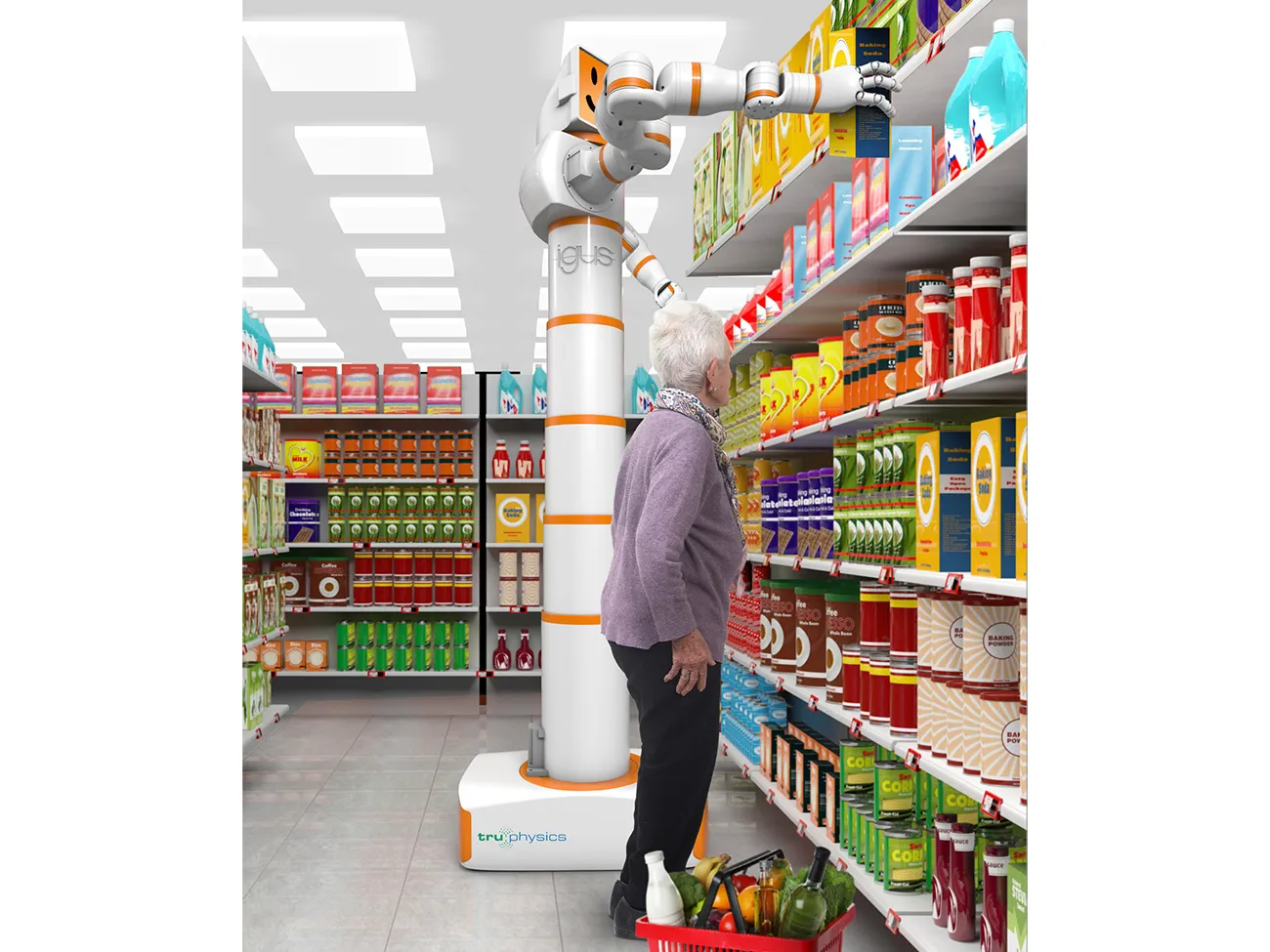
At Hannover Messe 2022, igus presented the first prototype of a low-cost humanoid robot
Human, machine, or both? Humanoid robots left the realm of science fiction long ago and entered the real world. igus has also been interested in humanoid robotics for some time, and presented a prototype of the “motion plastics bot” at Hannover Messe, a humanoid robot that combines the advantages of high-performance polymers with those of low-cost automation.
Robots are an integral part of our everyday lives. Since the transition to Industry 4.0 began, more and more tasks have been automated, a trend that is also benefiting new forms of robotics. Robots make things easier in industry, and they can do the same in our daily lives. A humanoid that is friendly, has human-like features and is functional can become a partner to people, rather than just a machine. Research and development in humanoid robotics continue to advance. One example is a team of researchers at Chemnitz University of Technology in Germany, which is developing “e-skin”, a touch-sensitive electronic skin that could make humanoid robots even more human. Constantly considering how robotics might evolve, igus has also been working for some time on its own vision of a humanoid robot, the “motion plastics bot”. “The igus ReBeL system and our drytech product range already provide us with suitable components for moving a robot. The humanoid robot is a project involving robotics specialists from Stuttgart-based startup TruPhysics, who assembled the intelligent humanoid using our motion plastics and other components. It is available there under the name Robert M3,” explains Aurélien Erson, drylin Project Manager at igus France. “With this robot, we want to demonstrate how our high-performance polymer products can interact with integrated intelligence at an affordable price.”
A lightweight, low-cost humanoid with no maintenance requirements
igus tribopolymers offer a decisive advantage for the “motion plastics bot” to operate reliably over the long term: they require no lubrication. These high-performance polymers also enable a lightweight design. As a result, the robot weighs just 78 kilograms, despite being up to 2.70 m tall. Its reach is 1.50 m. The motion plastics bot is equipped with an AGV (automated guided vehicle), a telescopic torso and a head with an integrated screen and avatar for interactive communication. Another key component is the igus ReBeL, a service robot with collaborative capabilities that will act as the “motion plastics bot’s” arm. Elliptical gearboxes made from tribopolymers, fully integrated with a motor, absolute encoder, force control and controller, are the heart of the ReBeL. The “motion plastics bot” moves at walking speed and has a payload capacity of 2 kilograms per arm. As an open-source solution, it is controlled via ROS (Robot Operating System). The entire igus low-cost automation portfolio can be represented in ROS. With the “motion plastics bot” study, igus combines the advantages of its high-performance polymers for motion applications with its expertise in low-cost automation, to drive forward the next generation of robots.
A lifelong companion rather than just a machine
“We believe humanoid robots have enormous potential. But the world we live in was designed by humans, for humans. It therefore makes sense to work on humanoids and androids, rather than limiting ourselves to partial automation. When will the market realise this? That is the question,” says Aurélien Erson. Humanoid robots can carry out dangerous operations as well as simple, repetitive tasks. In the workplace, they can perform tasks beyond simple pick-and-place operations, already handled by robot arms. At home, a “bot” could replace several robots. It could vacuum the house, mow the lawn, do the shopping, cook and do the laundry, as well as take care of any number of other tasks, including looking after people who are ill. It would therefore be more than just a machine: it could be a companion that makes life easier for us throughout our lives. “Using such a robot is still very expensive, but the cost would be recouped over the long term, given its long service life,” explains Aurélien Erson. “Our aim is to present affordable, straightforward solutions for humanoid robotics, using our motion plastics components.”
Question about this story? Ask your question
Companies in this story


Keep following this
Get an email when a new story is published. No account needed.
- ThemeHigh-performance drives and precise motion
- SubjectMotion & drives
- CompanyHANNOVER MESSE
- Companyigus